


The first sign that air inside a home is not as clean as it should be is rarely dramatic. It is more often a faint smell that never quite disappears, condensation that lingers too long on the windows, or a room that feels heavy by late afternoon. People tend to blame weather, fatigue, or “just dust,” but indoor air has a personality of its own. It reflects habits, materials, and routines. In many UK homes, especially newer sealed builds and older retrofitted terraces, that personality has become a bit stale.
Most people assume outdoor pollution is the real threat and indoors is the safe zone. Measurements often show the opposite. Cooking releases fine particles and nitrogen dioxide. Cleaning sprays hang in the air longer than expected. Candles and incense add pleasant scent but also soot. Even furniture and carpets quietly release chemicals for years. None of this is catastrophic on its own, but together it creates a low, constant exposure that the body notices before the mind does.
Ventilation remains the simplest and most underused tool. Not just opening a window once a day, but thinking about airflow as a pattern. Cross-ventilation — two openings on opposite sides — clears a room far faster than a single tilted window. In UK winters people hesitate to open windows for more than a few minutes, yet even five minutes of full opening can exchange a surprising volume of air. Short and sharp works better than cracked open all day. Bathrooms and kitchens benefit most, especially right after showers or cooking.
Extractor fans are often installed and rarely trusted. Some are too weak, some are noisy, some are switched off to “save heat.” Yet a functioning extractor in a kitchen removes combustion gases and moisture at the source, which is always more effective than trying to clean air later. If the fan sounds like a distant hairdryer and barely moves a tissue when held near it, it is decorative, not functional. Upgrading a fan is not glamorous, but it changes the daily baseline.
Cooking habits matter more than people like to hear. Frying at high heat without a lid produces a visible plume if sunlight catches it just right. Gas hobs add another layer — combustion byproducts — even when the flame looks clean. Using lids, turning on extraction early, and lowering heat slightly reduces particle release without turning dinner into a science project. Induction hobs, where possible, are noticeably cleaner in measured tests, though replacement is not a quick decision for most households.
Moisture is the quiet amplifier. Damp air holds pollutants longer and feeds mould growth behind wardrobes and in corners where air barely circulates. The UK climate makes this a recurring battle. Drying laundry indoors without ventilation can push humidity past safe levels in a few hours. A small dehumidifier in a drying room or bedroom often does more for air quality than another scented product ever will. Keeping relative humidity roughly between 40% and 60% is not just a technical recommendation; it changes how a room feels.
Houseplants are often presented as natural air filters, which is comforting and only partly true. In laboratory conditions, certain plants remove small amounts of specific chemicals. In real rooms, their effect is modest unless you are prepared to live in something resembling a greenhouse. Their real benefit is indirect: people who care for plants tend to ventilate more, dust more carefully, and notice their environment. That behavioural shift does more work than the leaves.
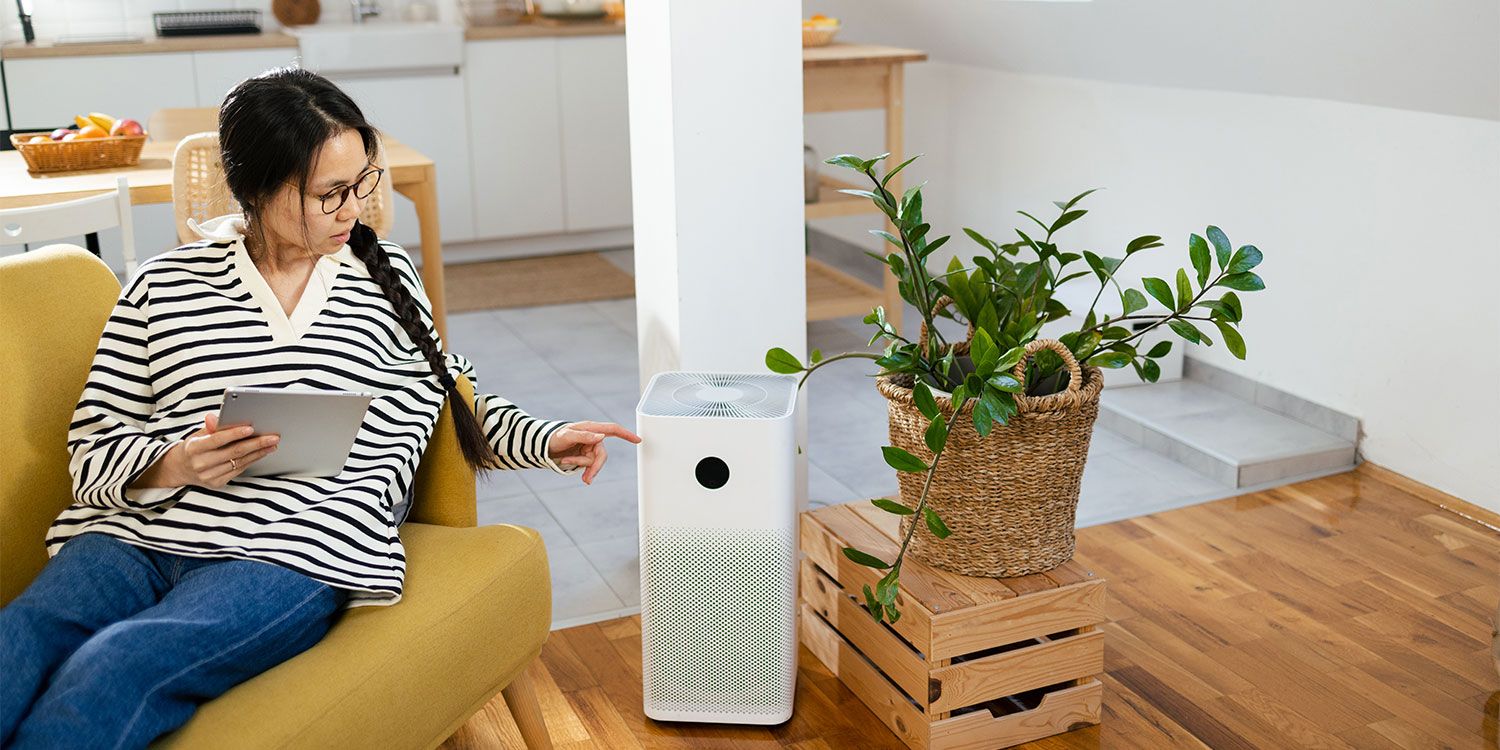
Air purifiers help, but only when matched to the room and the problem. A unit with a true HEPA filter can reduce fine particles from smoke, pollen, and traffic pollution that drifts indoors. It will not fix damp or remove cooking gases. Placement matters — not hidden behind a sofa, not pushed into a corner — and so does maintenance. A clogged filter is like a full vacuum bag: technically running, practically useless. The CADR rating, which many buyers ignore, tells you whether the device can actually cycle the room’s air volume.
I remember visiting a newly renovated flat that looked immaculate but made my throat feel oddly scratchy within minutes.
New materials release gases — paints, varnishes, composite woods, adhesives. The smell of “new” is a chemical event. Letting renovations air out for days, sometimes weeks, with strong ventilation is more than superstition. Low-VOC products help, though labels vary in strictness. If a room smells sharp, the air is still busy reacting.
Cleaning routines can either improve or damage indoor air. Dry dusting simply redistributes fine particles; a slightly damp cloth captures them. Vacuum cleaners need sealed systems and decent filters, or they turn into particle blowers. Sprays and aerosols linger; liquids applied to cloths produce fewer airborne chemicals. Mixing products — especially anything involving bleach and acids — creates dangerous gases more often than people realise.
Shoes at the door sound like etiquette advice, but they are also air quality control. Outdoor particles — tyre dust, pollen, heavy metals from road residue — come in on soles and become airborne again when disturbed. Households that adopt no-shoes rules consistently measure lower indoor particle loads. It is a small behavioural shift with measurable effect.
Bedrooms deserve special attention because exposure is longest there. Mattresses and bedding collect allergens. Washing sheets hot enough to kill dust mites, airing duvets near an open window, and not overfilling the room with soft furnishings reduces reservoirs. Even the position of a bed — not pressed against a cold external wall — can limit hidden mould growth.
Smart monitors have made invisible air more visible. CO₂ monitors, particle counters, humidity sensors — once specialist tools — are now affordable. They reveal patterns people rarely guess correctly. CO₂ spikes during video calls in closed rooms. Particle levels jump during toast making. Humidity climbs overnight with doors closed. Watching numbers change alters behaviour faster than advice alone.
Urban UK homes face another twist: outdoor pollution varies by hour. Ventilating during lower traffic periods — late evening, early morning — can bring in cleaner air than rush hour airing. Homes near busy roads benefit from window opening on the quieter side when possible. Timing becomes part of the ventilation tips people rarely discuss but quickly learn through experience.
Scent is not proof of cleanliness. Many air “fresheners” mask rather than remove pollutants, and some add their own chemical load. Neutral air often smells like almost nothing. That absence is a better sign than a strong artificial fragrance, however pleasant.
Small habits accumulate. Lid on the pan. Fan on before steam rises. Window open wide, briefly. Filters changed on schedule. Laundry dried with airflow. None of it feels dramatic. Yet when visitors walk in and say the place feels fresh without knowing why, that is usually the sum of these quiet choices rather than any single device marketed to improve indoor air quality UK homes are now being urged to monitor more carefully.
Air, after all, records how we live — every shortcut, every improvement — and gives the verdict slowly.
