


Estate agents often talk about “good light” as if it were a permanent feature, like brick or square footage. But light is rarely fixed. It is arranged, directed, softened, sharpened, and sometimes badly misunderstood. The same room can feel expansive at noon and cramped at 7 p.m., generous under one lamp and interrogative under another. Lighting design is less about brightness than about perception, and perception is surprisingly easy to manipulate.
Small rooms are the easiest place to see this in action. A narrow hallway with a single central ceiling fixture tends to look like a tunnel, because the brightest point sits in the middle and the walls fall away into shadow. Add low wall washers or evenly spaced sconces, and suddenly the boundaries become visible; the corridor appears wider even though nothing moved. The eye measures space by contrast lines. When edges are lit, the brain reads distance more generously.
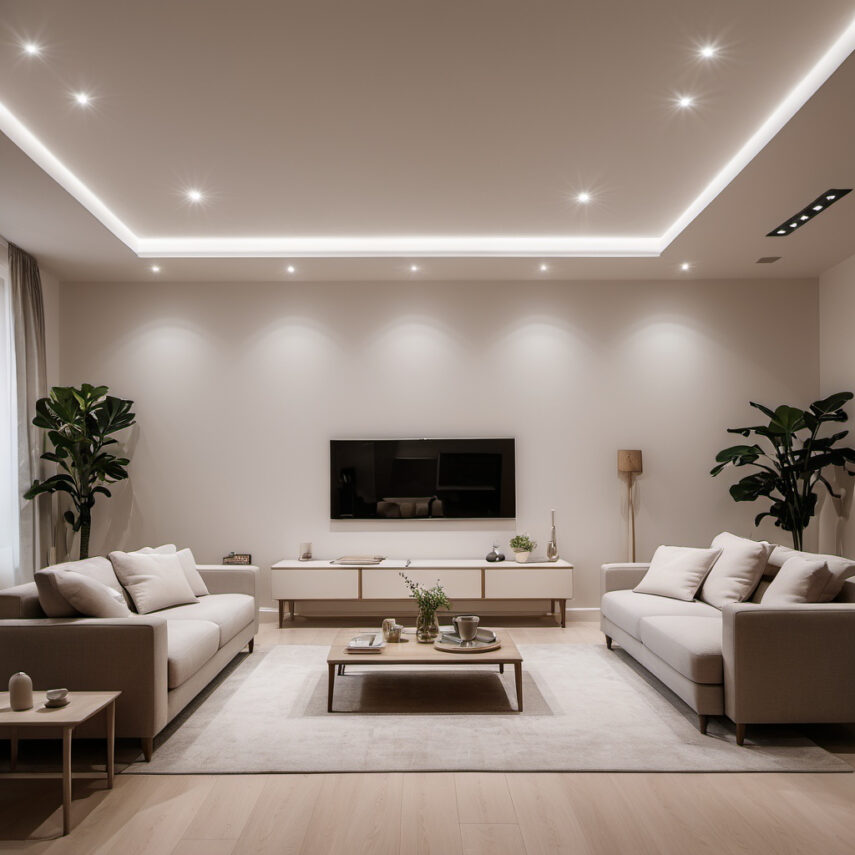
Ceiling height is also negotiable, visually speaking. Uplighting — whether from floor lamps that throw light upward or concealed LED strips along coving — creates a lifted effect. The ceiling becomes a reflector instead of a lid. In many UK terraces with modest ceiling heights, designers quietly rely on this trick. By contrast, a heavy downward pendant with an opaque shade pulls attention toward the floor and compresses the vertical feel. Neither is right or wrong. They simply tell different spatial stories.
Colour temperature complicates things further. Cooler light, often above 4000K, sharpens edges and textures. It makes surfaces feel crisp and defined, which can make a compact kitchen feel more precise but also slightly smaller. Warmer light softens transitions and blends corners, which can make living rooms feel more relaxed and sometimes larger. People assume warm equals dim and cool equals bright, but measured output can be identical; it’s the psychological reading that shifts.
Retail has understood this for decades. Walk into a boutique clothing shop and notice how perimeter lighting is often brighter than the centre. The walls glow, mirrors sparkle, shelving pops forward. The store feels deeper than it is. Supermarkets do the opposite with certain aisles — flat overhead lighting, minimal shadow — because clarity and speed matter more than spatial drama.
Layering remains the most repeated advice in every interior lighting guide, but it’s repeated because it’s still ignored. Ambient, task, and accent lighting each serve different perceptual roles. Ambient light establishes the base visibility. Task light defines functional zones — reading chairs, kitchen counters, desks. Accent light creates focal depth by highlighting art, textures, or architectural features. When only the ambient layer is present, rooms feel emotionally and spatially flat. Add layers and the eye starts mapping distance between bright points.
Corners deserve more attention than they usually get. Dark corners visually “cut off” a room. Designers often place a lamp or directional spotlight into a corner not for function but for geometry. Illuminate the corner and the boundary extends. Leave it dark and the space visually stops short. It’s a subtle manipulation, but once noticed, it becomes hard to unsee.
Window light and artificial light also compete in odd ways. During daytime, strong artificial lighting can actually make a room feel smaller if it overpowers natural light, because it cancels the gradient that suggests depth. Soft supplementary lighting works better — lamps that support rather than challenge the window. In the UK, where daylight hours fluctuate dramatically by season, adjustable lighting becomes less of a luxury and more of a spatial control system.
Fixture scale plays its own psychological game. Oversized pendants in small dining rooms often make the room feel intentionally proportioned rather than cramped, because the brain reads the fixture as a design anchor instead of an intrusion. Tiny fixtures scattered across a large ceiling can produce the opposite effect — the space feels underpowered and oddly compressed. Scale signals confidence or hesitation.
I remember being surprised how a single floor lamp in the far corner of a studio flat made the whole place feel as if a wall had shifted outward.
Shadows are not the enemy people think they are. Even lighting — the kind produced by grid panels or poorly planned downlights — removes shadows and with them removes depth cues. Museums rarely light galleries evenly. They sculpt with shadow so objects appear dimensional and rooms feel layered. Homes benefit from the same restraint. A bit of shadow suggests distance; total uniformity suggests a box.
Reflective surfaces multiply these effects. Gloss paint, mirrors, glass tables, polished stone — all bounce light and extend perceived volume. But uncontrolled reflection creates glare, which shrinks comfort even if it enlarges perception. The trick is angled reflection, not direct bounce. This is why many lighting design tips in UK renovation guides recommend matte finishes near eye level and reflective finishes above or below typical sightlines.
Directional lighting changes how we read texture, which in turn alters spatial judgment. Grazing light — placed close to a wall and aimed across it — exaggerates texture and makes surfaces feel closer and more tactile. Flood lighting flattens texture and pushes surfaces back. Brick walls, timber panels, and plaster finishes all respond differently. The choice is interpretive, almost editorial.
Open-plan spaces depend heavily on lighting boundaries instead of walls. A pendant over a dining table creates a room within a room. Under-cabinet strips define a kitchen zone without partitions. A reading lamp and rug establish a corner library without shelves. Without these cues, open plans can feel like aircraft hangars with furniture scattered inside. With them, they read as connected but distinct territories.
Brightness control matters more than maximum output. Dimmers are not mood accessories; they are spatial instruments. Lower light levels narrow perceived space and focus attention. Higher levels expand it. Smart lighting systems are increasingly popular in UK homes precisely because they allow scene changes that reshape perception hour by hour. Morning kitchen, evening lounge, late-night pathway — same fixtures, different spatial reading.
There is also a social dimension. People gather where light pools. Restaurants know this and create islands of brightness over tables while keeping circulation paths slightly dimmer. Homes that rely on a single central ceiling light often struggle with this — everyone gravitates to the middle, and the edges go unused. Distributed lighting distributes behavior.
Bad lighting rarely announces itself directly. It shows up as vague dissatisfaction: a room that never feels quite right, a corner no one sits in, a workspace that feels tiring. Good lighting is often invisible because it aligns with how we naturally read space. You notice the room, not the fittings.
And once you start paying attention, you can’t enter a space without silently mapping where the light is coming from and what it’s trying to make you believe about the size of the place.
