


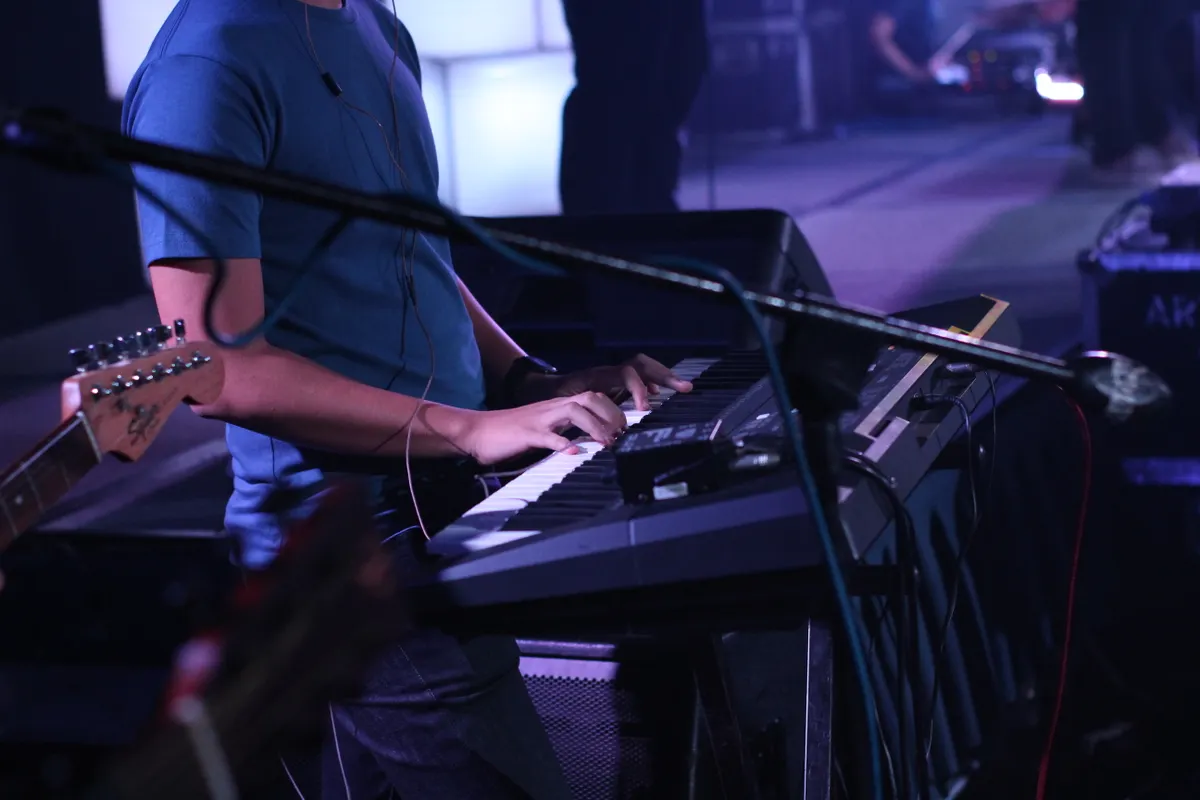
The story of Jordan Rudess’s Dream Theater role is, at its core, a story about translation: between classical music and prog, between prog and metal, and between a keyboard player who hears orchestration where his bandmates hear Billy Joel. In a 2019 interview, Rudess looked back on the unlikely journey that brought him into one of prog-metal’s most demanding bands, and explained how he has spent years learning to make his ideas legible to musicians who came from an entirely different place.
From Juilliard to Emerson, Lake and Palmer: an unlikely foundation
Rudess’s formal training began at nine years old, when he attended the Juilliard School‘s Pre-College Division. The environment was, by his own account, close to dogmatic. ‘The Juilliard training was so intense, whenever they spoke of music other than classical it was drummed into us that the artists responsible were lower-class citizens,’ he said. ‘I was almost brainwashed by that.’ The discovery of progressive rock through Emerson, Lake and Palmer’s album Tarkus came as a genuine jolt. ‘It was so alien to me,’ he recalled. ‘I didn’t know what to do with it.’
That tension between his conservatoire background and the music that actually lit him up never fully disappeared. It became, instead, the defining characteristic of his playing and, later, of his particular place inside Dream Theater.
The audition, the Dregs, and the long road in
Dream Theater first appeared on Rudess’s radar around the time of their 1994 album Awake, when Kevin Moore was still their keyboard player. ‘I thought: “Wow, they have the virtuoso thing going on. They play prog but they also have a feel for metal, and everything is so clean.”‘ When the band subsequently offered him an audition, he took it, even playing one show with them at an event called the Foundations Forum.
He turned them down. At the time, he and his wife had a small child, and a part-time arrangement with Dixie Dregs suited his life better. What followed, though, was Liquid Tension Experiment, a side project with Dream Theater members John Petrucci and Mike Portnoy. That, Rudess said, felt like his only real opportunity to play with them, and he welcomed it. ‘Tony Levin is a brilliant musician who came from another world to those guys, so I was the “in between guy.” Thinking about it now, that’s almost my role in Dream Theater, to keep things balanced.’
When Dream Theater called a second time, he was ready. He joined just ahead of the recording of Metropolis Part 2: Scenes From A Memory, an album that many fans regard as one of the band’s career peaks. ‘When I agreed to join them I had no idea of the life change it would bring,’ he said. ‘I had never travelled the world. They had a lifestyle that I’d only seen from a distance. Suddenly the doors were blasted open.’
Jordan Rudess Dream Theater role: orchestration, metal, and the Billy Joel problem
The integration was not instant in every sense. Rudess brought an instinct for orchestration (for layering sounds and textures rather than sticking to a single tone) that initially made the rest of the band nervous. ‘At the start that to them was like, “Ew!”‘ he said. The other members’ reference points ran through Iron Maiden, Metallica, Yes and Queensrÿche. Rudess’s primary loyalties were to classical music, then Emerson, Lake and Palmer, King Crimson, Gentle Giant and Pink Floyd. The band covered entire albums by Iron Maiden (The Number Of The Beast) and Metallica (Master Of Puppets) early in his tenure, which meant Rudess had to learn to replicate second guitar parts on keys.
The gap shows up in a recurring comedic scenario he described with some candour. ‘There have been times when I’ve taken the band something that I consider to be a really heavy riff and they’ve given me a sideways look and said, “That sounds like Billy Joel to us!”‘ As a keyboard player, he noted, the instrument carries cultural associations that a guitar riff does not, and he has had to learn to account for that when presenting ideas.
What he brought in exchange was compositional range and, crucially, a chemistry with Petrucci. ‘John Petrucci really needed a partner to inspire and keep up with him,’ Rudess said. That mutual push, built on the groundwork laid during Liquid Tension Experiment, meant his acceptance inside the band came quickly despite the stylistic negotiations.
For anyone curious about his classical roots, Rudess points to Prokofiev’s piano concertos as an entry point for sceptics, and to Glenn Gould’s recordings of Bach as proof that the repertoire can surprise you. The training that once felt like a cage, it turns out, became the thing that made his Jordan Rudess Dream Theater role genuinely irreplaceable: nobody else in that band hears music quite the way he does, and that friction is precisely the point. The full interview originally appeared in Louder Sound.
