


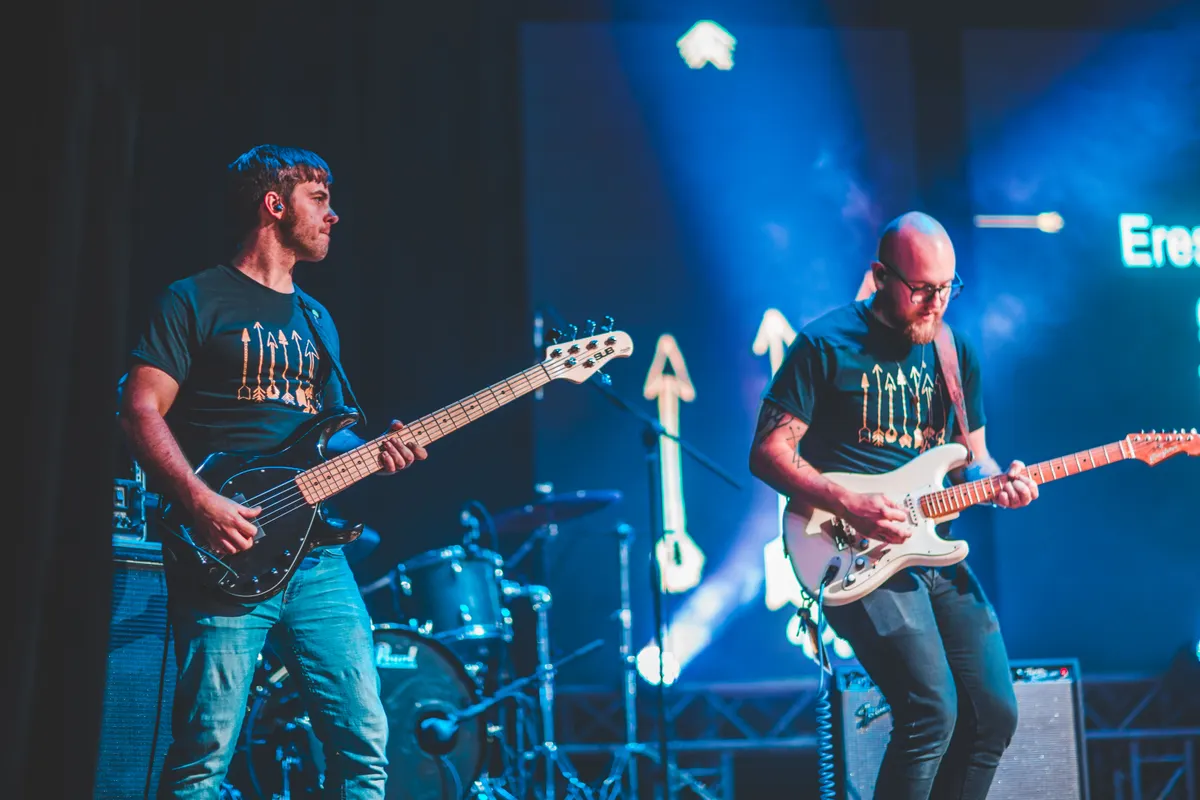
Bruce Watson Big Country Redux guitarist Bruce Watson has opened up on the music that shaped him, from a childhood Beatles fixation to touring with The Rolling Stones, and the revelation that the Stones are, in his words, ‘the quietest band on stage I’ve heard in my life.’
It is the kind of detail that lands differently when it comes from someone who has actually stood in the wings and watched. Watson says he did two tours with the Stones in the nineties, often positioning himself behind Charlie Watts. ‘You can actually talk over the top of them playing,’ he says. ‘They play through these little Fender amps. It sounds like they’re playing in a local pub.’ The backstage atmosphere, he adds, matched it: warm, relaxed, the kind of vibe where, during Sympathy For The Devil, the backing vocalists would bring a microphone round and anyone present got to sing the ‘ooh-ooh’s.
Big Country Redux and the album with unfinished business
Watson is talking as Big Country Redux prepares to release Eastworld on 19 September, followed by a UK tour in November and December. The album draws on material from the vaults that the classic line-up never got around to recording, and Watson has been candid about the impulse behind it. ‘There was unfinished business,’ he says simply.
According to the Big Country Official Website, Eastworld comprises 10 brand new recordings of Big Country songs originally written or co-written by Stuart Adamson, Tony Butler and Bruce Watson, material that now carries extra weight given that Adamson died by suicide in 2001 at the age of 43. That ended the band’s first run, and the loss has never entirely left the story Watson tells about his own career.
This year has also brought an acclaimed biography of the late frontman by Classic Rock’s Scott Rowley, adding to a concentrated burst of activity around the Big Country name. Watson reflects that when Adamson quit The Skids in 1981 to form the band, neither man was aiming particularly high. ‘To be honest, I’d have been happy just to put out one single, or get a Peel Session, that was my ambition,’ he says. ‘But it went a lot further.’
Watson on the records that made him
The first music he remembers is A Hard Day’s Night. Watson was probably five years old, he says, and the opening chord (‘I think it’s two guitars, a bass and a piano’) struck him as one of the greatest intros ever written. He had a plastic guitar for Christmas and would stand in front of the television and take a bow whenever The Beatles did at the end of a performance.
His live debut came with a punk band called The Delinquents, opening with Wild Thing. That band supported The Skids in Dunfermline, and Watson, determined to make a visual impact with a ‘shitty little practice amp’, built a fake Marshall stack from cardboard boxes, painted black, with beer bottle lids for volume knobs. Someone opened the fire exit. The whole thing blew away.
For greatest album of all time, Watson goes to Marquee Moon by Television. Before the pandemic, playing a show in New York, he heard a support act soundchecking in the next room, thought ‘that guitar player is really spot-on,’ walked in and found it was Richard Lloyd. ‘You fucking what?!’ was his response to the promoter’s confirmation.
His guitar hero, he says, is probably Mick Jones, and not for technical reasons. ‘He looked so brilliant with a guitar.’ Watson loved The Clash wholesale, the songs, the energy, and what Jones went on to do with Big Audio Dynamite. As a singer, he points to Alex Harvey: ‘the most dangerous vocal delivery of all time.’ He recalls going into a record shop to hear The Impossible Dream in 1974, the shop assistant laughing at him, and walking out resolved to save up three weeks of paper-round money to buy it.
Joe Strummer, though, takes the songwriter slot. Watson nominates The Clash‘s (White Man) In Hammersmith Palais as his favourite lyric, specifically the line: ‘I’m the all-night drug-prowling wolf who looks so sick in the sun.’ ‘It conjures up so many images,’ he says. ‘If I was ever to get a tattoo done, I’d have those lyrics tattooed somewhere.’ The same song is the one that ‘touches me most in life’, though for his funeral, he has settled on Alex Harvey’s Anthem instead. ‘It’s very evocative. And it’s very Scottish.’
His guilty pleasure is Love Grows (Where My Rosemary Goes) by Edison Lighthouse, a song he acknowledges is built for aunties and uncles at a wedding. He hates key changes as a rule, but concedes this one earns it. Brown Sugar is his Saturday-night party song: ‘instantly danceable,’ and ideal, he says, if you’ve had a few pints and want to jump about. For the songs that make him cry, he goes to anything Richard Manuel sang for The Band, Tears Of Rage, I Shall Be Released, Whispering Pines.
Eastworld is released on 19 September, with a UK tour to follow in November and December.
